
Perspectives: Peter Clifford on Female Participation in Motorcycle Racing
In its twentieth season, the Red Bull MotoGP Rookies Cup has become one of the most formidable proving grounds on the road to Grand Prix racing.

Twenty-six teenagers from 19 nations lined up for the 2026 campaign, racing identical Moto3-spec KTMs at Grand Prix circuits and under the watch of the very paddock they are pining to enter. For two decades, the championship has helped develop riders who have gone on to become Grand Prix winners and World Champions, while creating perhaps the closest approximation junior motorcycle racing can offer to life inside MotoGP before a rider actually gets there.
Yet across that history, only four of its riders have been female.It is a striking disparity, although the Red Bull Rookies Cup Director of Rider Development and Media, Peter Clifford, is not convinced that the answer lies simply in creating more opportunities at the top of the junior ladder.

After more than half a century in motorcycle racing, Clifford has watched the sport change around him. His career has taken him from journalism and television commentary to ownership of the WCM Grand Prix team and, since the Rookies Cup's inaugural season in 2007, the development of some of motorcycle racing's most promising teenagers.
When it comes to women in racing, however, one question remains stubbornly unresolved.
Where are all the girls?
The sharp end of the Road to MotoGP
It is a question that the Red Bull Rookies Cup has confronted in its tenure. Unlike a junior championship operating several steps removed from Grand Prix racing, its riders compete at MotoGP weekends, on many of the same circuits they hope eventually to race in Moto3. According to Clifford, that environment is an important part of what makes the Cup such effective preparation.

"The fact that riders go from the Rookies Cup to immediately being able to battle for podium places in Moto3 shows what a preparation it is," he explained.
"They also experience the atmosphere and see what it's like so that when they turn up in the GP paddock, they feel at home. They know the circuits, they know the people, the whole thing is no surprise to them, no shock to them."
It is also an environment in which very little can be hidden. The riders are teenagers, but the stakes surrounding them are already distinctly professional. Team managers, sponsors and senior paddock figures are watching; a strong season can materially alter the direction of a career. Clifford makes no attempt to pretend that pressure does not exist.
"Racing is pressure, isn't it? And the Rookies Cup is at the sharp end," he said.

"We certainly don't put the pressure on the riders. We try to take it off. But you can't take the pressure off. It's there."
"They know they're performing in front of the major teams and in front of the team managers and the sponsors and everything. That's the reality."
For a female rider entering that environment, there is another obvious difference. She is very likely to enter it alone. In 2025, Alejandra Fernández became only the fourth female rider to compete in the Red Bull MotoGP Rookies Cup and the first since Beatriz Neila in 2017. Fernández entered a field of 26 riders as its sole girl. For Clifford, that inevitably created an additional challenge, although not necessarily for the reasons often assumed.
"Of course, it's more of a challenge, as you say, because she's the only female of the group," he said.

Yet he was equally keen to stress that the Rookies Cup is deliberately unfamiliar for everybody. Riders arrive from environments in which they may previously have had a team built around them. In Rookies, much of that insulation disappears.
"They're used to having a team that surrounds them, that is focused entirely on them. And the Rookies Cup environment isn't like that."
"You don't have the whole team, everybody telling you how wonderful you are all the time, which actually is a good thing, because that's what they need to understand when they're going into the big bad world."
Fernández also entered the championship with less experience alongside many of her contemporaries, some of whom had already spent years racing one another through championships such as the European Talent Cup and JuniorGP.
Rather than interpreting every difference in her behaviour through the prism of gender, he described Fernández simply as a naturally quiet teenager who was arriving without many of the pre-existing relationships enjoyed by other riders in the paddock. On track, meanwhile, there is little accommodation for anybody.

"No one cares," Clifford said when asked whether treatment changed once Fernández was racing.
"Maybe because she's a girl, there are some of them that are determined not to be beaten by a girl. I couldn't tell you."
What he had not witnessed was any systematic mistreatment of Fernández by the riders around her. Female participation in motorcycle racing is often discussed as though the central barrier must be what happens once a girl arrives in an elite paddock. Clifford's experience points towards a more complicated problem. Increasingly, the paddock may be waiting for female talent; there simply is not enough of it reaching the door.
An opportunity problem, or a numbers problem?
Clifford has been attending Grands Prix since the early 1980s. In those years, the appearance of a female rider was sufficiently unusual to be remarkable in itself. He recalls a history populated by occasional exceptions: Beryl Swain, Gina Bovaird, Taru Rinne and Katja Poensgen among them. Female participation existed, but never in anything approaching meaningful numbers.
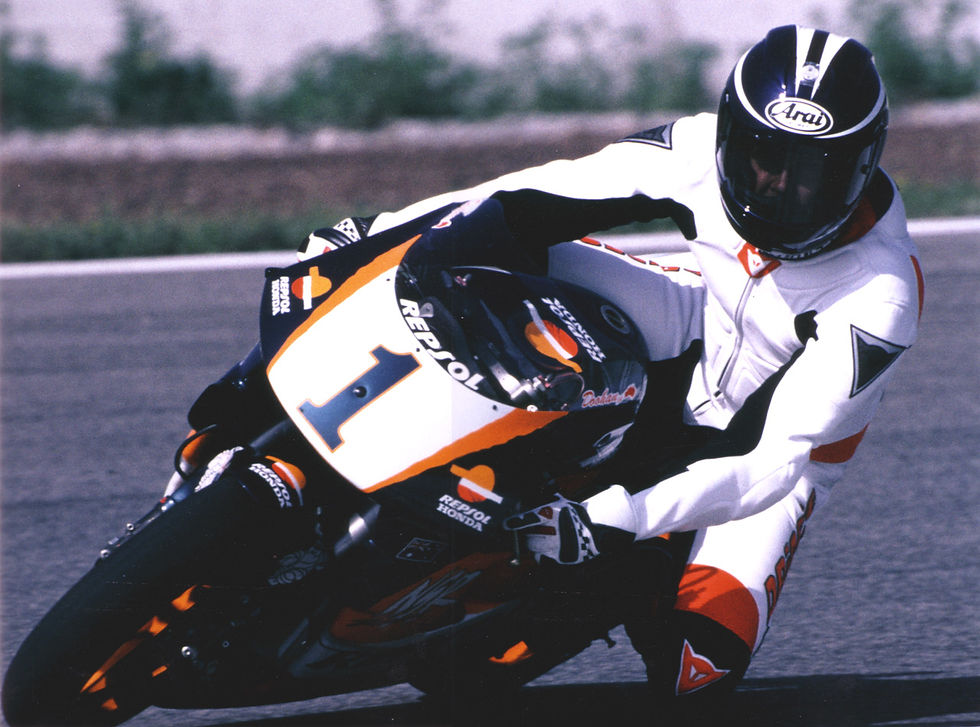
What has changed, in Clifford's view, is the appetite surrounding it. Motorcycle manufacturers, championship organisers and sponsors are no longer indifferent to the possibility of a successful woman reaching Grand Prix racing. Quite the opposite.
"There is a huge opportunity now because everybody's looking for the female rider, the first successful Grand Prix rider, Grand Prix winner, World Champion, whatever," he said.
"If you're a female rider with talent, someone is going to give you an opportunity. The opportunities are there."
"I think the problem now is not lack of opportunity. It's just lack of girls. It's purely numbers."
That does not mean every structural barrier facing a female rider has disappeared. Nor does the existence of somebody willing to sign a talented girl mean that she has enjoyed an equal journey in reaching the point at which she can be signed.

Instead, Clifford's argument shifts the point at which the problem needs to be examined.
The Rookies Cup casts internationally for talent, when we spoke at the end of 2025, Clifford pointed to 265 riders from 44 nationalities having passed through the championship while only four had been female. The Cup has not been unwilling to recruit girls. Indeed, Clifford recalled María Herrera being invited to join for 2012 before instead accepting an alternative opportunity with a Spanish team.
Fernández's selection provides another example. Clifford freely acknowledged that she arrived at the selection event with less experience than many of the riders around her. The Cup could have sent her away for another year. Instead, seeing sufficient ability, it elected to give her the opportunity immediately.
"She was kind of, if you like, on the limit of: shall we take Alejandra this year or not? And we said yes," Clifford explained.
Her rookie campaign was difficult. Illness compounded the experience deficit she was already attempting to overcome, but internally the Cup saw the characteristic it values most from a developing rider: progress.

"That's what we look for more than anything to invite a rider back for the following year, is progress. And she was making progress."
Fernández returned to the Rookies Cup grid in 2026, becoming the only female rider in this year's 26-rider field once again. Her results also expose why representation at this level cannot be reduced to the symbolic importance of simply being there. Rookies is designed to find Grand Prix racers, Fernández, like every rider around her, must ultimately be judged on whether she can develop quickly enough to compete with them.
Clifford does not argue otherwise and that philosophy colours his view of the rapidly developing world of female-only motorcycle racing. WorldWCR has created something that scarcely existed when most of Clifford's career unfolded: an international World Championship in which female riders are guaranteed an entire grid, professional infrastructure and a global platform.
Its impact is difficult to dismiss with riders who may otherwise have struggled to find an international programme presented with the invaluable opportunity to race with the support of an established world championship, in this case, the WorldSBK championship.

"I think anything that encourages more people to go riding and if girls feel more comfortable in that, and it gives them opportunities... fantastic. Absolutely brilliant," Clifford said.
There is also now meaningful movement between the two worlds Clifford discussed. Former Rookies Cup rider Beatriz Neila finished just five points short of the WorldWCR crown in 2025 before joining the JuniorGP grid for the final two rounds of that season. In 2026, she is again fighting for the WorldWCR title, sitting second to María Herrera with one round remaining after winning Race 2 at Donington. Herrera leads with 226 points to Neila's 182 heading to Jerez.

That crossover is perhaps precisely what the emerging female racing structure needs. For Clifford, however, female-only competition cannot become the final measurement of whether a rider is capable of progressing towards MotoGP.
"Unless girls are competing in an open championship against guys... then they're not going to ultimately prove themselves," he said.
Women's championships can provide opportunity, experience and visibility and they can help riders who might otherwise disappear from international racing entirely. Yet if the objective is ultimately Moto3, Moto2 or MotoGP, the benchmark remains the same grid those riders will eventually need to join.

"It's only going to take them so far," Clifford argued. "Ultimately they've got to prove themselves in the open categories."
Equality in racing cannot simply mean manufacturing a separate destination for female riders. If championships such as WorldWCR are also capable of producing riders who move into open categories, they can become something more consequential: another point of entry into a development system from which girls have historically disappeared. And it is that disappearance, rather than what happens once they reach elite racing, which may be the more urgent question.
Clifford’s most revealing observation came not from the Grand Prix paddock, but from grassroots motocross. Watching his sons race at club events in New Zealand, he has seen girls make up a substantial proportion of the youngest riders, sometimes around a third of those competing at five, six, seven or eight years old. That balance gradually shifts as the children get older.

“You see gradually as time goes on, you see less girls at age 10, less at 14, less at 16,” he said. “And I don’t know why that is.”
In other words, the disparity visible at the top of motorcycle racing does not begin there. By the time riders are old enough to enter championships such as the Rookies Cup, much of that attrition has already taken place.
Clifford is also cautious about treating any junior result as a definitive measure of where a rider will eventually end up. After almost two decades of watching teenagers pass through the Rookies Cup, he has seen riders dominate at that level and struggle afterwards, while others whose potential appeared less obvious have gone on to become World Champions.
“Predicting how, when we see a rider at 15 or 16 or 17, how they’re going to be at 20 or 21, we find it totally impossible,” he said. There are exceptions, Pedro Acosta, Clifford recalls, looked like “a God-given talent” from the moment he first saw him at the Rookies Cup selection event.

Most young riders are considerably harder to read, Beatriz Neila is one example. Her Rookies Cup season was badly disrupted by injury and, Clifford believes, left her questioning whether she wanted to continue racing at all. He could not have predicted then that she would later become one of the leading riders in WorldWCR.
“There’s no way I could predict that she’s been able to achieve what she has achieved, which is fantastic,” he said.

It is perhaps why the distinction between female-only and mixed competition matters less as a choice between two competing models than as a question of what each can contribute to a rider’s development. Clifford is unequivocally supportive of championships which give women an international platform and allow more riders to remain in the sport, but equally clear that riders aiming for Grand Prix racing will eventually have to demonstrate their ability in open competition.
For a championship built around finding what comes next, that remains the essential test. The Rookies Cup cannot manufacture a future MotoGP rider, male or female. It can identify ability, provide opportunity and expose young riders to an unusually demanding environment. What happens from there is considerably less predictable.

And perhaps that is where the current generation of female riders should be viewed too. Not as proof that motorcycle racing has solved its participation problem, nor as representatives required to justify every initiative designed to support women in the sport, but as young riders whose careers are still being formed. Clifford has spent long enough watching supposed certainties disappear and unlikely prospects succeed to know how little can be settled at 15 or 16.
*All images without credit were kindly supplied by Peter Clifford for editorial use


Comments