
Do All-Female Racing Series' Create Opportunity or Reinforce Separation?
The existence of all-female racing championships continues to provoke a familiar debate.

For some, categories such as F1 Academy and the FIM Women’s Circuit Racing World Championship (WorldWCR) represent a necessary response to the barriers that have prevented women from progressing through motorsport at the same rate as men. They provide visibility, seat time and opportunities that may otherwise remain inaccessible.
For others, separating female competitors from mixed grids risks reinforcing the very divide the sport is attempting to overcome. Motorsport is not segregated by regulation. Women are permitted to compete against men across its major categories. Why, then, should separate championships be necessary?
The question is reasonable. The answer is more complicated than either side of the debate often allows. All-female championships are not a perfect solution to the underrepresentation of female competitors in motorsport. They cannot substitute for a healthy grassroots system, sustainable financial support or credible opportunities to progress into mixed competition.
It is crucial they do not become a parallel ecosystem in which women race primarily against other women while the upper levels of the sport remain largely unchanged. However, it is undeniable they do still matter. The value of a female-only championship lies not in separation for its own sake, but in its ability to address the conditions that have made intervention necessary in the first place.
When structured carefully, these categories can keep careers alive, create professional opportunities and make women visible within a sporting culture that has historically offered them too few routes forward. Their success should not be judged by their existence alone. It should be judged by where they lead.
Motorsport may be mixed, but opportunity has never been evenly distributed
Unlike many sports, motorsport does not require separate categories for men and women at its highest levels. There is no rule preventing a woman from competing in Formula 1, MotoGP or the Superbike World Championship.
That fact is frequently used to suggest that all-female championships are unnecessary. If the regulations already permit equal participation, the argument goes, talented women should simply earn their places on mixed grids.

The problem is that formal access is not the same as equal opportunity. A young driver or rider does not arrive at an elite championship through talent alone. Motorsport careers depend on years of competitive mileage, substantial financial backing, access to equipment, professional coaching, physical preparation and relationships with teams and sponsors. Small disparities at the beginning of the pathway compound quickly.
When fewer girls enter karting or motorcycle racing, fewer progress into national competition. When fewer are racing competitively at junior level, fewer have the opportunity to attract funding, gain experience and develop at the pace required to reach the international stage.
By the time the sport begins looking for its next Formula 1 driver or MotoGP rider, the talent pool has already narrowed considerably.
All-female series do not exist because women are incapable of racing against men. They exist because too few women have historically received the sustained opportunities required to reach the same grids.
The lesson of W Series
It is important to cast our minds back past recent memory and consider that this debate did not begin with the introduction of F1 Academy.
W Series launched in 2019 as a free-to-enter, all-female single-seater championship intended to create opportunities for women who had struggled to secure the funding required to continue their careers. It provided a valuable platform for drivers including Jamie Chadwick, Alice Powell, Beitske Visser, Marta García, Abbi Pulling and Nerea Martí.
Its impact should not be dismissed. Chadwick won three titles before progressing into Indy NXT and later endurance racing. Several W Series competitors subsequently found opportunities in F1 Academy and other categories. The championship placed women on major race weekends and introduced a wider audience to drivers whose careers may otherwise have received far less attention.

Its collapse also exposed an important weakness. The final three races of the 2022 season were cancelled after expected funding did not materialise. The championship did not return. Its drivers had gained visibility and race experience, but the wider pathway remained uncertain.
W Series demonstrated that simply creating an all-female grid is not enough. A championship must be financially sustainable. It must provide meaningful development rather than a temporary holding pattern. Most importantly, drivers need somewhere credible to go after they leave.
The question is not whether all-female series should exist. It is whether their design creates lasting opportunities beyond their own paddocks.
F1 Academy and the importance of a pathway
F1 Academy has increasingly positioned itself as one part of a broader system. The Formula 4-level championship gives young women the opportunity to race in front of the Formula 1 paddock, with support from established junior teams and direct involvement from Formula 1 teams. Its drivers receive visibility on Grand Prix weekends, but the championship has also placed growing emphasis on progression before and after a driver reaches its grid.
The structure is intentionally temporary; drivers can ordinarily compete for a maximum of two seasons, while champions cannot return to defend their titles. The restriction is vital because it prevents F1 Academy from becoming a destination in itself. Seats must continue to open for the next group of young drivers.
F1 Academy has also expanded its reach below the championship through its Discover Your Drive initiative, wildcard entries and rookie testing. These programs are designed to identify and support girls earlier in their development, rather than waiting until they are already competing in single-seaters.

The early results are encouraging; eight former wildcard drivers from the 2024 and 2025 seasons secured full-time places on the 2026 grid. Payton Westcott became the first driver to progress from the Discover Your Drive karting program into F1 Academy. Other young karters connected to the initiative have entered Formula 1 team development programs before reaching single-seaters.
At the other end of the pathway, F1 Academy champions have received opportunities to step into more advanced machinery. Marta García moved into the Formula Regional European Championship after winning the inaugural title in 2023.
Abbi Pulling progressed into GB3 after her dominant 2024 season and returned to the championship for a second year in 2026. Doriane Pin has combined endurance racing with development roles for Mercedes and Peugeot after claiming the 2025 crown.
These outcomes are not identical, nor should they be. F1 Academy has not yet produced a simple, repeatable route from its grid to FIA Formula 3 and Formula 2. The costs and competitive pressures of climbing the single-seater ladder remain considerable.
Pulling’s efforts to secure the backing required for a second GB3 campaign illustrate the continuing difficulty of sustaining a career even after winning the championship.
The answer is not to dismiss F1 Academy because its graduates have not immediately reached Formula 1. No development category can guarantee that outcome. The more useful question is whether it gives drivers a better chance to progress than they would have had without it. The evidence increasingly suggests that it does.
WorldWCR serves a different purpose
The FIM Women’s Circuit Racing World Championship must be considered on its own terms. Launched in 2024, WorldWCR is a single-make championship contested on Yamaha R7 machinery within the WorldSBK paddock. Its 2026 grid features 24 riders representing 12 nationalities across a six-round calendar.

Now in its third season, the championship has continued rotating circuits while giving women the opportunity to race on an international stage alongside established World Superbike categories. The context differs from F1 Academy which is explicitly positioned as a development championship within the junior single-seater ladder. WorldWCR brings together riders with a much wider range of experience.
Some are emerging competitors gaining their first sustained international opportunity. Others have already raced across major categories. Maria Herrera, the reigning WorldWCR champion, previously competed in Moto3, WorldSSP300, WorldSSP and MotoE. Ana Carrasco, the inaugural champion, had already made history as the first woman to win an individual motorcycle road racing world championship after claiming the WorldSSP300 title in 2018.
For riders with careers as established as Herrera and Carrasco, WorldWCR cannot be described simply as a feeder series. It is also a world championship in its own right. That does not make progression irrelevant. WorldWCR provides something women in motorcycle racing have rarely been offered at this scale: a visible, competitive international platform with equal machinery and sustained coverage.
The single-make format places greater emphasis on rider performance. Racing within the WorldSBK paddock allows competitors to build relationships with teams, sponsors and audiences. Beatriz Neila, the vice champion of 2025, races under WorldSBK’s factory Yamaha squad (known as Ampito Crescent Yamaha in WorldWCR) offering Neila the guidance of team principal and one of motorsports paragon’s of leadership; Paul Denning.

Its long-term impact will depend partly on what happens around it. Can young riders use WorldWCR to progress into mixed national and international categories? Will teams identify talent from its grid and offer opportunities in World Sportbike, WorldSSP or elsewhere? Will the championship strengthen the pipeline beneath it, encouraging more girls to enter minibike racing and national competition in the first place?
The answers will take time to emerge. It would be unfair to expect a new championship to solve decades of underrepresentation within three seasons. It would be equally unhelpful to judge its success only by the quality of the racing within its own field.
The importance of national competition
It is easy to focus only on the categories that feature on the world stage. When discussing the underrepresentation of women in motorsport, attention naturally gravitates towards the absence of female competitors in championships such as Formula 1, MotoGP and WorldSBK. These remain important conversations. However, focusing solely on the highest levels of the sport can overlook the progress already being made in national competition.
Across several domestic championships, women are participating in mixed categories; better yet they are fighting for podiums and race victories. Tara Morrison provided a significant example during the opening round of the 2025 Australian Superbike Championship at Phillip Island. Racing in the fiercely competitive Supersport 300 category, Morrison became the first female rider to win a race in the class. Her victory was not the result of a small or depleted grid; the race featured 41 competitors, with Morrison timing her final-lap move to defeat Jordy Simpson by just 0.058 seconds. The top eight riders crossed the line within one second of the winner.

The setting made the achievement particularly meaningful. The ASBK season opener was held alongside the opening round of the WorldSBK Championship, giving Morrison the opportunity to make history on one of the most prominent weekends of the Australian motorcycle-racing calendar.
Kayla Yaakov offers another compelling example in the United States. Yaakov became the first female rider to win a MotoAmerica race when she claimed victory in the Junior Cup category in 2022, shortly after her 15th birthday. She has since continued progressing through the American racing system and now competes in MotoAmerica Supersport with Rahal Ducati Moto.
Her results demonstrate the value of giving talented young riders time to develop within mixed competition. At the opening round of the 2026 season, Yaakov finished third in the Daytona 200, becoming the first woman to stand on the podium in the history of the prestigious race. She has remained a regular presence towards the front of the Supersport field, recording four podium results across the opening five races of the season.
Morrison and Yaakov are not arguments against the existence of women-only championships. Their success reinforces why those championships must be connected to a wider racing ecosystem. National championships are an essential part of that picture. They may not always receive the same attention as world-level competition, but they offer some of the clearest evidence that women can fight for results on merit when they are given the machinery, support and experience required to do so.
Visibility matters, but it must lead somewhere
One of the most important contributions of women-only championships is also one of the most difficult to quantify. The visibility provided changes and, at times, warp, expectations. When girls see women competing on Formula 1 and WorldSBK weekends, racing no longer appears to be an environment in which they would be an exception.
When sponsors see female competitors building audiences and delivering results, investment becomes easier to justify. When teams work directly with talented women, assumptions can be replaced by evidence. Representation does not guarantee progression. It can create the conditions that make progression more likely. The risk arises when visibility becomes the final measure of success.
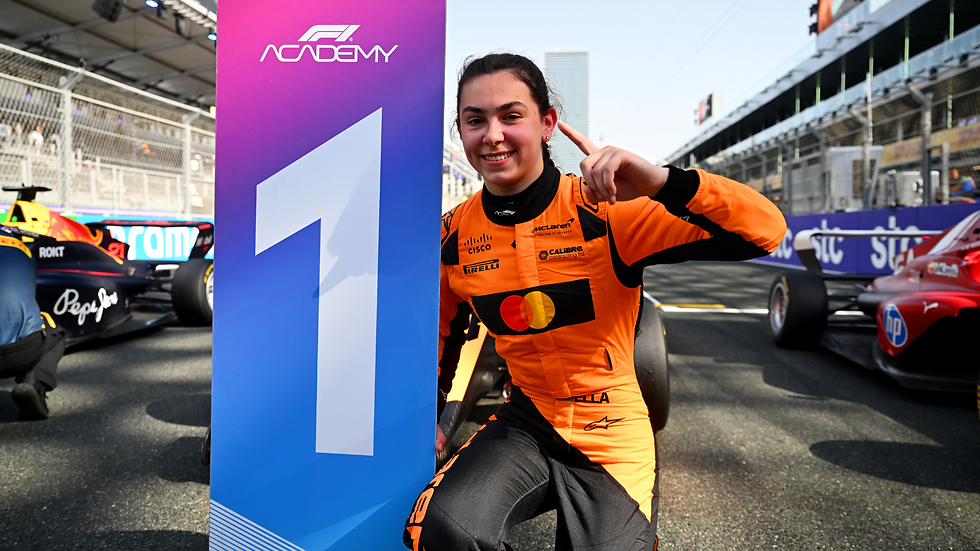
A championship cannot be treated as transformative solely because its drivers appear on prominent race weekends or attract attention online. Media exposure is valuable, but exposure without sustainable opportunities can leave competitors in a familiar position once the season ends: visible, experienced and still searching for the funding required to continue racing.
This is where the surrounding structure becomes essential. Seat time matters. Coaching matters. Testing matters. Physical preparation matters. Technical feedback matters. Access to experienced teams matters. Financial support matters most of all, because without it even the most promising next step may remain out of reach. A successful women-only championship should not shield its competitors from mixed racing indefinitely. It should prepare them for it.
There is room for both support and scrutiny
It is possible to support women-only championships while still asking difficult questions about their purpose.

Are drivers receiving enough mileage to develop meaningfully? Are the strongest competitors able to move into mixed categories? Are opportunities available beyond the champion alone? Is the series connected to grassroots initiatives that expand the talent pool beneath it? Are sponsors investing in long-term careers or only short-term visibility?
These questions are not attacks on the existence of F1 Academy or WorldWCR. They are necessary if the championships are to fulfil their potential.
Women-only categories should not be expected to repair every structural issue in motorsport. The barriers facing female competitors existed long before these championships were created and extend far beyond the boundaries of any one paddock.
The ultimate goal is not a motorsport landscape in which women have their own categories and men dominate the rest. It is a sport in which women-only championships are no longer carrying the burden of creating opportunity almost alone.
Until that point, they still matter. Their success will be measured by how many doors they open beyond their own grids.


Comments